The ranking of top-rated health insurance companies in the United States is determined through a combination of measurable variables including customer satisfaction, financial stability, claims processing efficiency, provider network size, cost structure, and the breadth of benefits offered across plan tiers, and within this framework, a consistent group of insurers—Kaiser Permanente, UnitedHealthcare, Blue Cross Blue Shield, Aetna, and Cigna—emerges as dominant due to their scale, operational efficiency, and diversified plan offerings; however, “top-rated” status is not absolute but conditional, shaped by how each insurer performs across specific dimensions such as affordability, accessibility, flexibility, and long-term value rather than a single unified metric.
At the structural level, all major insurers operate within the regulatory framework of the Affordable Care Act, which standardizes plan categories into Bronze, Silver, Gold, and Platinum tiers, each defined by actuarial value rather than service quality, with Bronze plans covering approximately 60% of healthcare costs and offering the lowest premiums but highest deductibles, while Platinum plans cover up to 90% of costs with minimal out-of-pocket exposure but significantly higher monthly premiums, creating a trade-off spectrum that directly impacts both affordability and financial risk; this tiered system ensures comparability across insurers but does not eliminate variation in pricing, network structure, or additional benefits, which remain the primary differentiators among top-rated providers.
Kaiser Permanente consistently ranks at or near the top in customer satisfaction due to its vertically integrated model that combines insurance coverage with hospital and physician services, allowing it to streamline care delivery, reduce administrative inefficiencies, and maintain tighter control over pricing, resulting in lower premiums and more predictable cost structures compared to competitors, though this efficiency is achieved by restricting members to its internal network, limiting flexibility but enhancing coordination and preventive care outcomes. In contrast, UnitedHealthcare dominates in market share and network scale, offering access to one of the largest provider ecosystems in the country, which translates into high flexibility for policyholders who require specialized care or geographic mobility, though this scale introduces variability in pricing and plan complexity, making cost optimization more dependent on careful plan selection.
Blue Cross Blue Shield occupies a structurally unique position as a federation of independent regional insurers operating under a unified brand, allowing it to combine strong local provider relationships with national accessibility through programs like BlueCard, which enables cross-state care access, making it particularly effective for individuals and families seeking reliable coverage across multiple locations, while maintaining competitive pricing across HMO and PPO plan structures. Aetna differentiates itself through integration with CVS Health, embedding pharmacy services, retail clinics, and preventive care programs into its insurance offerings, thereby reducing friction in accessing routine healthcare services and enabling cost efficiencies through coordinated care and medication management, positioning it as a mid-range provider that balances affordability with service accessibility.
Cigna extends beyond traditional domestic coverage by incorporating international healthcare services and wellness-focused programs, making it structurally advantageous for individuals requiring global mobility or comprehensive mental health and preventive care support, though its premiums tend to be slightly higher than average, reflecting the added value of its expanded service portfolio. Emerging insurers such as Oscar Health introduce additional competitive pressure by leveraging digital infrastructure to reduce administrative costs, offering simplified user experiences, telehealth integration, and transparent pricing models that appeal to younger, technology-oriented consumers, though their network limitations prevent them from fully displacing established providers in top-tier rankings.
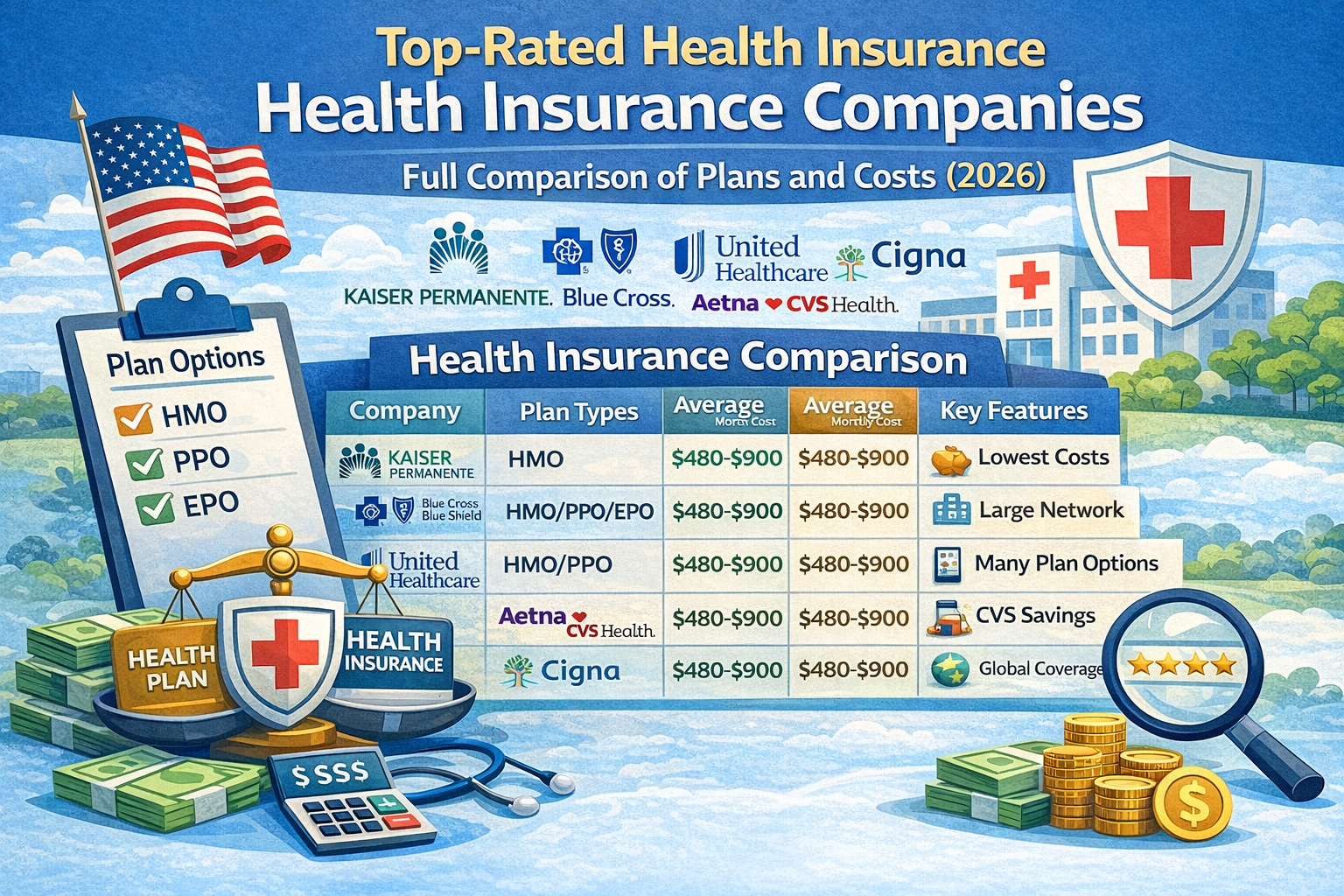
Cost comparison across these top-rated insurers reveals that monthly premiums for individual plans typically range from $400 to $800 depending on age, geographic location, and plan tier, with Bronze plans occupying the lower end of the spectrum and Gold or Platinum plans extending toward the upper range, while family plans scale these costs significantly, often exceeding $1,200 per month depending on coverage level and household size; however, premiums alone do not define financial burden, as deductibles, co-payments, and out-of-pocket maximums collectively determine total annual expenditure, with deductibles for mid-tier plans commonly ranging between $3,000 and $7,000 and out-of-pocket maximums approaching regulatory limits of approximately $9,000 for individuals and higher for families, reinforcing the necessity of evaluating total cost rather than isolated premium figures.
Plan structure further differentiates insurers, with HMO plans offering lower premiums and integrated care but restricting provider choice, PPO plans providing maximum flexibility at higher costs, and EPO plans eliminating out-of-network coverage while maintaining moderate pricing, and within this spectrum, Kaiser Permanente emphasizes HMO-style efficiency, UnitedHealthcare and Blue Cross Blue Shield prioritize PPO flexibility, and Aetna and Cigna maintain hybrid offerings that balance cost and access; these structural differences directly impact how policyholders interact with the healthcare system, influencing both convenience and long-term financial exposure.
Benefits have evolved into a critical competitive dimension, with top-rated insurers incorporating telehealth services, mental health coverage, preventive screenings, chronic disease management programs, and wellness incentives into standard plan offerings, thereby shifting value beyond basic coverage into proactive health management; UnitedHealthcare leads in digital innovation through advanced analytics and virtual care platforms, Kaiser Permanente excels in preventive care coordination, Blue Cross Blue Shield ensures consistent provider access, Aetna integrates retail healthcare services, and Cigna emphasizes holistic wellness and global support, collectively illustrating that benefit structures now play a central role in determining overall plan value.
The comparative evaluation of top-rated health insurance companies ultimately resolves into conditional alignment rather than hierarchical superiority, where the optimal choice is determined by the intersection of individual or family healthcare needs, financial constraints, and desired level of provider flexibility, with cost efficiency favoring integrated models like Kaiser Permanente, network breadth favoring UnitedHealthcare and Blue Cross Blue Shield, service integration favoring Aetna, and global coverage favoring Cigna; the decision framework therefore requires analyzing not only premiums and deductibles but also structural compatibility between plan design and expected healthcare usage, ensuring that total cost, access, and service quality remain optimized over time rather than evaluated in isolation.