Affordability in the United States health insurance market is not defined by low premiums alone but by the total cost structure across an entire year, including deductibles, co-payments, co-insurance, and out-of-pocket maximums. In 2026, rising healthcare inflation, increased utilization of medical services, and expanding provider costs have made affordability a complex calculation rather than a simple price comparison. The most affordable health insurance providers are those that balance monthly premiums with manageable out-of-pocket expenses while still offering reliable access to care. Among the leading companies in this category are Kaiser Permanente, Aetna, Oscar Health, Molina Healthcare, and Cigna. Each operates with a distinct pricing strategy and target demographic, influencing how affordability is experienced by different groups.
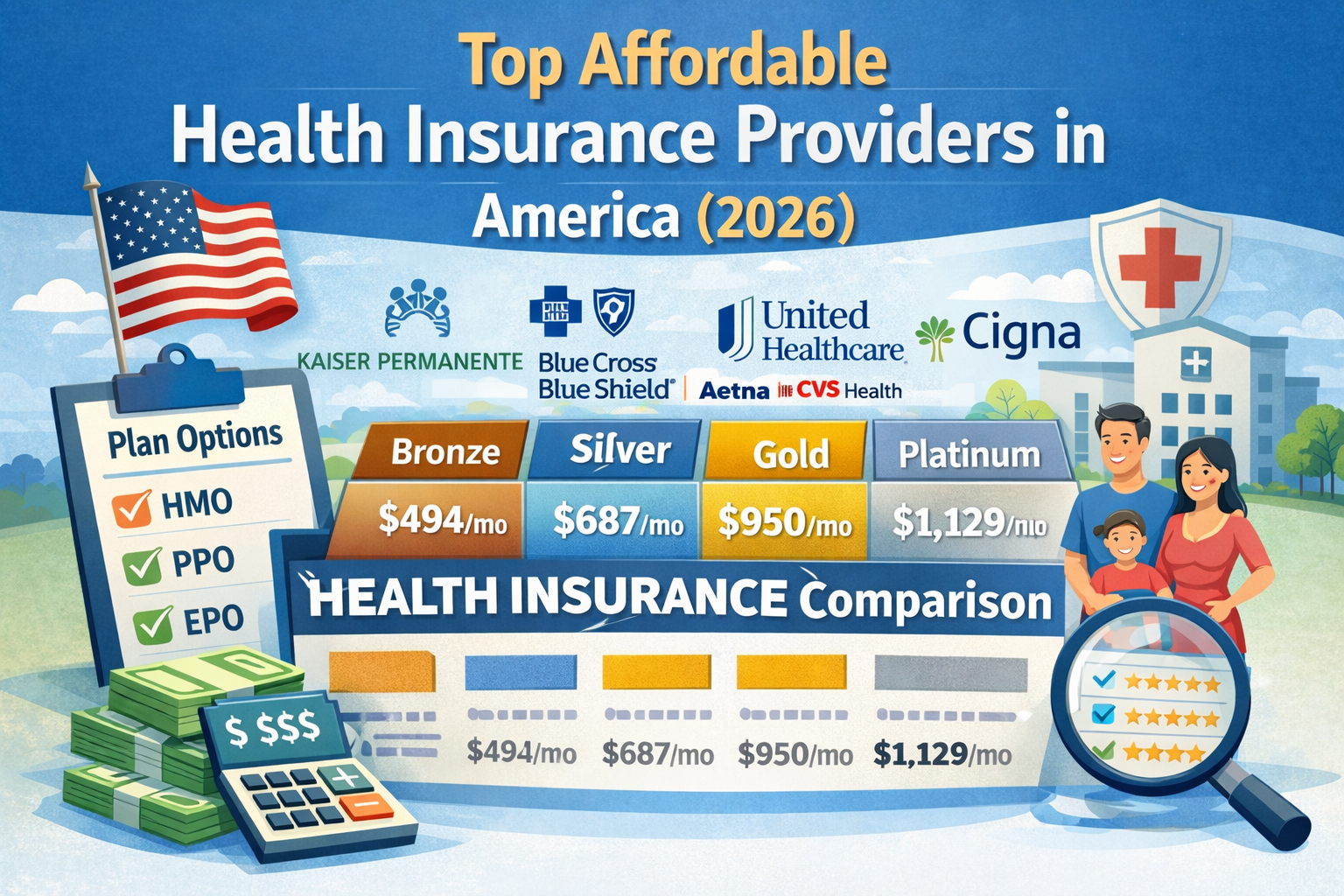
Health insurance plans in the U.S. marketplace are structured into four metal tiers—Bronze, Silver, Gold, and Platinum—under the Affordable Care Act framework. These tiers do not reflect the quality of care but rather how costs are distributed between insurer and policyholder. Bronze plans typically carry the lowest monthly premiums but require the highest deductibles, often exceeding $6,000 annually. These plans are economically efficient only for individuals with minimal healthcare needs, as most routine expenses are paid out-of-pocket until the deductible is met. Silver plans represent the most balanced option, offering moderate premiums and reduced cost-sharing, especially for individuals eligible for subsidies. Gold and Platinum plans, while significantly more expensive monthly, reduce financial risk by lowering deductibles and co-payments, making them suitable for individuals with chronic conditions or frequent medical usage.
Kaiser Permanente consistently ranks as one of the most affordable providers due to its vertically integrated healthcare model. By operating its own hospitals and physician networks, the company minimizes administrative inefficiencies and controls service pricing more effectively than competitors. Its Bronze and Silver plans often fall below national average premiums, with Silver plans commonly priced in the mid-range compared to other insurers. However, affordability within Kaiser Permanente is contingent on remaining within its closed network, which limits flexibility but enhances cost predictability.
Aetna positions itself as a balanced-cost provider, offering competitive premiums alongside relatively low complaint rates and stable service quality. Its integration with CVS Health introduces cost-saving mechanisms through pharmacy access, preventive care programs, and chronic disease management. Aetna’s Bronze plans are often priced slightly above the lowest-cost competitors but compensate through better service reliability and broader network access. Its Silver-tier offerings are particularly competitive for individuals seeking moderate premiums without excessive deductibles.
Oscar Health targets a younger, technology-oriented demographic by reducing operational costs through digital infrastructure. Its affordability is driven by telemedicine integration, streamlined claims processing, and reduced reliance on physical administrative systems. Oscar plans frequently include low co-pays for virtual care and transparent pricing structures, making them appealing to individuals who prioritize convenience alongside cost. However, its network coverage is narrower compared to larger insurers, which can affect accessibility in certain regions.
Molina Healthcare operates primarily within government-supported programs, making it one of the most affordable options for low-income individuals and families. Its plans are heavily subsidized under Medicaid and ACA marketplaces, significantly reducing premium costs for eligible users. Molina’s affordability advantage lies in its focus on essential healthcare services, though this often comes with more limited provider networks and fewer premium-tier benefits compared to private insurers.
Cigna occupies a slightly higher cost bracket but offsets this through value-added services such as wellness programs, mental health support, and international coverage options. While its premiums may exceed those of budget-focused providers, the inclusion of preventive care initiatives and global healthcare access enhances long-term cost efficiency, particularly for individuals with complex or international healthcare needs.
Cost comparison across these providers reveals that monthly premiums for Bronze plans typically range between $350 and $550, while Silver plans fall between $450 and $750 depending on geographic location, age, and tobacco use. Deductibles for lower-tier plans often exceed $5,000, while Gold plans reduce deductibles to approximately $1,500–$3,000 but increase monthly premiums substantially. Out-of-pocket maximums, which cap annual healthcare spending, generally range from $8,000 to $9,500 for individuals. These figures illustrate that affordability must be evaluated across total annual expenditure rather than isolated monthly costs.
Plan type further influences affordability. HMO plans are the most cost-effective due to restricted networks and referral requirements, making them suitable for individuals willing to trade flexibility for lower costs. PPO plans, while more expensive, provide unrestricted access to specialists and out-of-network providers, increasing their appeal for individuals requiring specialized or geographically diverse care. EPO plans offer a compromise, maintaining lower costs than PPOs while eliminating out-of-network coverage, thereby simplifying cost structures.
Subsidies under the Affordable Care Act significantly alter affordability calculations. Premium tax credits and cost-sharing reductions can lower monthly premiums and out-of-pocket expenses for eligible individuals, particularly those selecting Silver-tier plans. These subsidies effectively reposition mid-tier plans as the most economical choice for many households, despite higher nominal premiums compared to Bronze plans.
Comparative evaluation indicates that no single provider universally dominates affordability. Kaiser Permanente leads in low-cost integrated care, Aetna balances pricing with service quality, Oscar Health reduces costs through digital efficiency, Molina Healthcare serves the lowest-income segments with subsidized plans, and Cigna delivers higher-cost plans with expanded service value. The determining factor is alignment between plan structure and individual healthcare usage patterns.
Affordability in 2026 is defined by optimization rather than minimization. Selecting the cheapest premium without regard to deductible exposure results in higher long-term costs under moderate or high healthcare usage. Conversely, selecting higher-premium plans without sufficient utilization leads to unnecessary financial burden. Effective decision-making requires aligning plan tier, provider network, and subsidy eligibility with expected medical needs, ensuring that total annual expenditure—not monthly premium—remains controlled.